Register S CorpWhat this address refuses.
How these pages are made, what they refuse, and who publishes them.
Read the stop.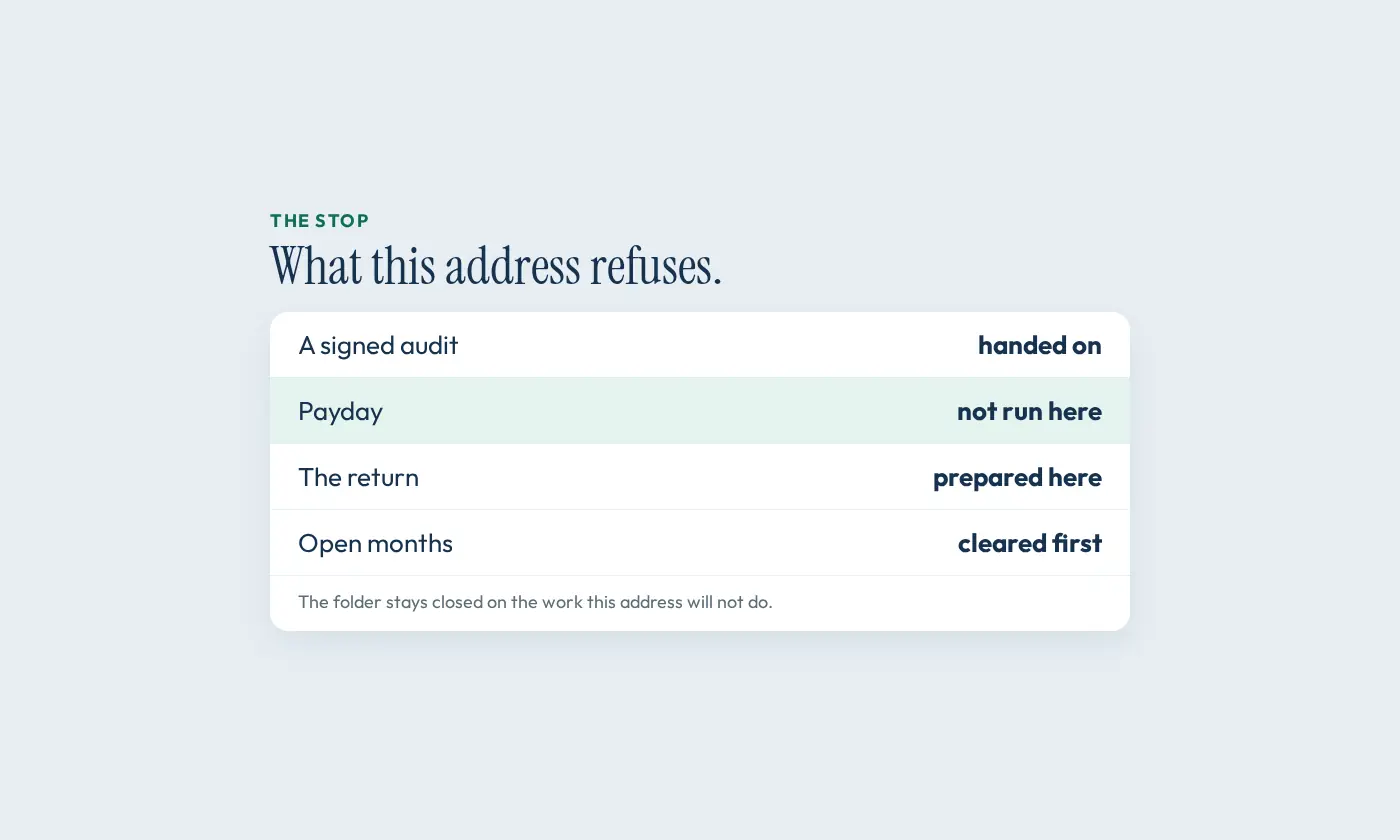
How these pages are made, what they refuse, and who publishes them.
Read the stop.A draft on this address begins from the stack we actually see. A state receipt. A federal form that may still be blank. A question about whether the year has moved. The draft is read out loud by the person who will keep the page. When a line is wrong, the replacement shows up on the same URL the reader already bookmarked.
The stop further down stayed in place while the prose around it was written again, so this address would not repeat a sibling. Form 2553, the acceptance letter, the registered agent, and a state price this page will not freeze are the examples that stayed. Making a page shorter is not a way to offer a new service.
No client ledger is published here. A shop that appears is marked as invented in the same paragraph. A savings figure is not used.
A number goes on a page only when the office that issued it is named in that same sentence. A statute is cited by its section when we decide to cite one. If the source was an agency site, that sentence includes the address that was open. A rate that lives only in memory, with no page beside it, stays off the site.
No formation price for a generic state is printed on the national pages. The price sits on the schedule of the state that took the paper, and that schedule moves. Where one state's own instructions name a fee, the page about that state may repeat the figure beside the office that published it. A schedule that will move next season stays off a page that pretends the figure is permanent. The election clock is taken from the Form 2553 instructions. That clock is not collapsed into one date and handed to every company.
If a sample row is ever shown, it only shows how a file is shaped. It is not a year anyone should expect to copy.
A page is read for the offer, read for invented stories, and read for a payday promise before it stays up. The offer on the page is held against the stop further down. A story stays only if that same paragraph calls it invented, or if written consent exists and every name is gone.
A draft that repeats a search phrase in every paragraph goes back. A draft that treats a state receipt as a finished federal election goes back. A draft that promises this office will cut checks is thrown out before publish.
The fix is made on the page already open. The day a note points at a bad figure, that figure comes off. Gentler wording is not used to hide it. People use the number at the bottom of the page to send that note.
The boundary further down stays put while the sentences around it change. A writing pass does not move it.
We are not a CPA. Nobody here holds a CPA license. Nothing on this address is an attest report, and nobody here signs one. A lender packet that asks for a signed audit, a review, or a compilation is handed to a firm that can put that signature on the report. The first conversation says that out loud when the packet is the reason for the call.
What this address calls payroll is the setup of a provider the owner already uses. That provider keeps the wage calculation, the payroll returns, and the day people are paid. We do not run payday.
Speaking at an examination is outside every service this address lists. If a notice lands, the help available here is pulling the records together for the person who will speak.
On this side of the stop, the practice prepares a return, gives management advice, and prepares statements that promise no assurance. Anything that needs a signature on an assurance report goes to a firm built for that signature.
The occupations statute is the boundary we read for this practice. The page states the limit in ordinary words and leaves the section number off.
Open months are cleared here before any repeating close is offered. If that catch-up is refused, this practice stops before a fee is discussed.
Services on this site are provided by Steven Palmieri, Dallas, Texas. Call +1 844-324-7273 with the receipt in hand if the federal form is still blank. One writing covers the closed months and the return built from them.
Steven Palmieri publishes the pages. On the proof card the first line is Steven Palmieri and the next line is Tax CFO. Owners who have met Steven Palmieri before often shorten the introduction to Entrepreneur's CFO. No house number appears in the footer or in the structured data. The structured data names the phone and the practice, and then the block ends.
We speak as we. The work is the practice.
The practice keeps more than one public address because owners arrive holding different papers. A state receipt and an acceptance letter should not be forced to share one headline. The phone number is the same practice on every address. The only link that leaves this site points at stevenpalmieri.com, where the wider practice is described.
A lawyer still owns the company agreement and the question of who is liable. We can show which facts a form is asking for, and we can keep the tax calendar. We do not take the lawyer's place on that liability question.
The state filing and the federal election are separate acts. The state act creates the company or changes a fact that office stores, including who receives official mail. The federal act is Form 2553. The acceptance letter is what lets the tax year change. A nickname saved in bookkeeping software is none of those three.
The Form 2553 instructions are the clock. A filing is allowed during the year before the tax year starts, and it is allowed through two months and 15 days after the tax year starts. Every owner is not handed one spring date. A request after that window is a procedure, and the procedure is not an approval given in advance.
After the election is real, wages for the work come before money taken out by the owner. The payroll job here is introducing the company to a provider the owner already chose. We do not run payday. Money put in, money taken out, and profit left in the company stay in three different accounts.
A state may tax the company on its own rules after the federal election. Those rules are read for the state where the company files. A national page will not pretend one sentence covers every state tax.