Register S CorpWhat a state filing office keeps
The office records the company. Many states call it the secretary of state. It does not record the federal election.
See the record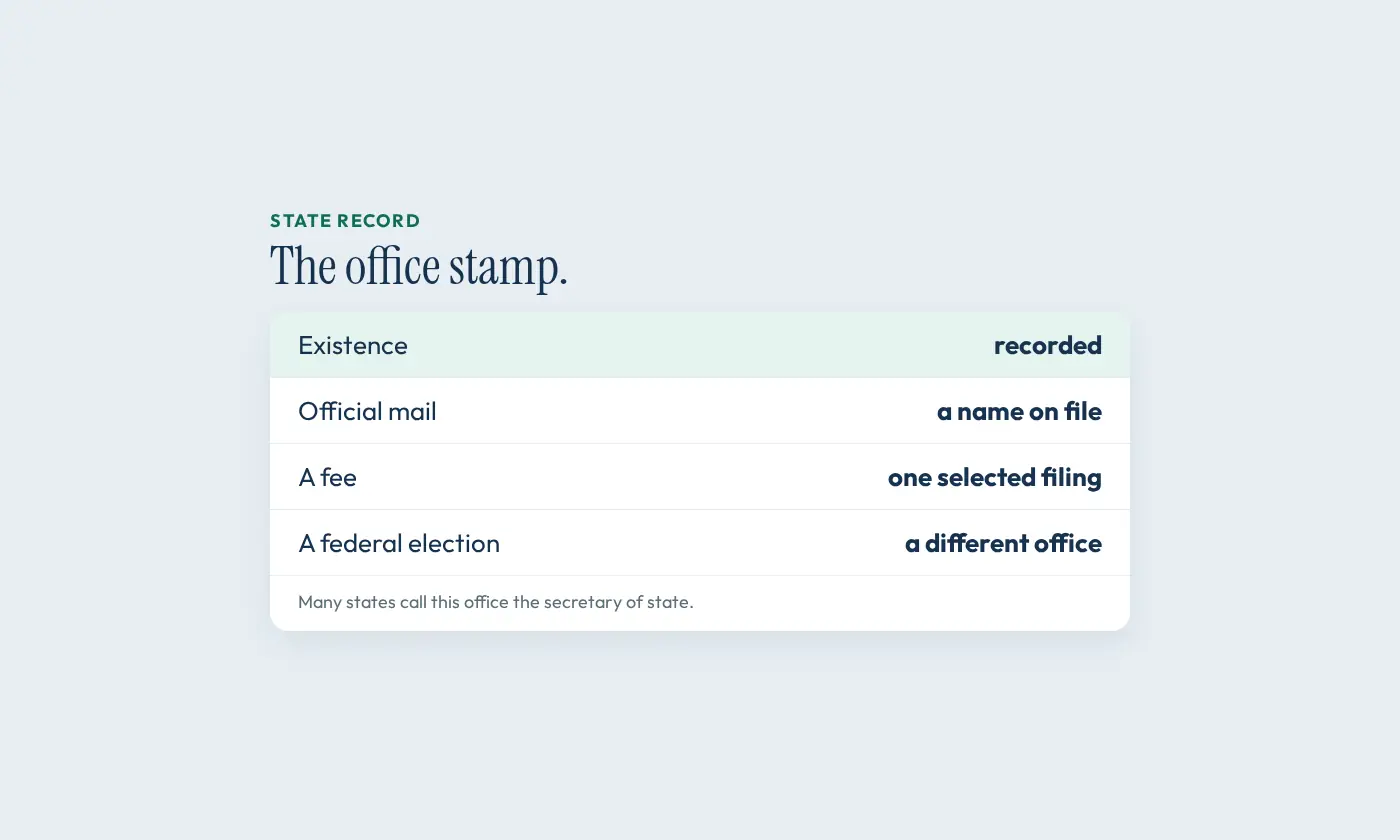
The office records the company. Many states call it the secretary of state. It does not record the federal election.
See the recordPeople say secretary of state because that is the name on the form in a great many states. The name is not a subject of one state. It is the ordinary label for the office that takes a formation paper, stores the company's public record, and hands back a receipt or a certificate. Other states use a different label for the same job. The job is what matters.
That office can usually tell you the company's name, the entity type, the registered agent, and the date existence began. It can tell you whether a later filing changed the agent or amended the name. It can tell you whether the company is in good standing under that state's own rules. It cannot tell you how the federal government will tax the year.
Owners search the state site, see the company listed, and feel finished. The listing is real. It is also narrow. A listed company can still have a blank federal form. We start from the listing and then ask for the other paper. The list and the blank form can share one afternoon.
The state record does not store Form 2553. It does not store the acceptance letter. It does not store the wage ledger, the contributions, or the profit left in the company. Those live in the federal file and in the books. Mixing the piles is understandable, because all of them feel like government paper. They answer different questions.
A status page on the state site sometimes shows a tax account the state itself opened. That account is the state's account. It is not the federal election. A company can owe a state report and still be waiting on a federal acceptance, or the reverse. We read the heading on the page before we treat the page as proof of anything.
Good standing is a state concept about filings and fees the state cares about. It is worth knowing. Good standing says nothing about which federal form was accepted. An owner can be in good standing and still have an open question about the election. We will not use a green check on a state website as a substitute for the acceptance letter.
On a first call we want the receipt or the certificate, and we want to know which filing it was. Formation, a change of agent, and a name amendment are different products sold by the same office. The receipt should name the product. If the PDF is long, the first page usually says what was filed. We follow that line and ignore the rest until it disagrees.
We also want the agent's name as the state shows it. If the public record names a service and your memory names a cousin, the record wins until it is amended. Official mail goes where the record says. A lawsuit does too. The books do not move with that mail. The agent and the ledger are different jobs, and only one of them is ours.
If the state site and your folder disagree, we believe the disagreement is the fact to solve. Sometimes a filing was paid and never completed. Sometimes a completion never got saved. The note can describe the disagreement in a sentence. We do not need the whole certificate pasted into a form.
When the state record matches the folder, the federal question is allowed to be the next question. Is the election form signed. Did the acceptance arrive. If both answers are yes, the books can follow that status. If either answer is no, the books should not pretend. A monthly close can still happen. The tax character of the year should not be invented to make the close feel complete.
Steven Palmieri keeps the ledger and prepares the return once that line is clear. The state office keeps the public record. The company that already cuts checks keeps that job after the acceptance arrives. A lawyer keeps the advice about liability and the company agreement. Four jobs sit behind one verb, and this page keeps only the state's record.
Bring the page from the state site or the receipt in the folder. Say whether the federal form is with it. That pair tells us whether the record is the whole story or only the first chapter.
Say what the state site shows and whether the federal form is with the receipt.

You will be talking to the Steven Palmieri practice.