Register S CorpWhat the payment to the state buys
The receipt covers one selected filing. The amount is on that state's schedule. It is not printed here.
Bring the receipt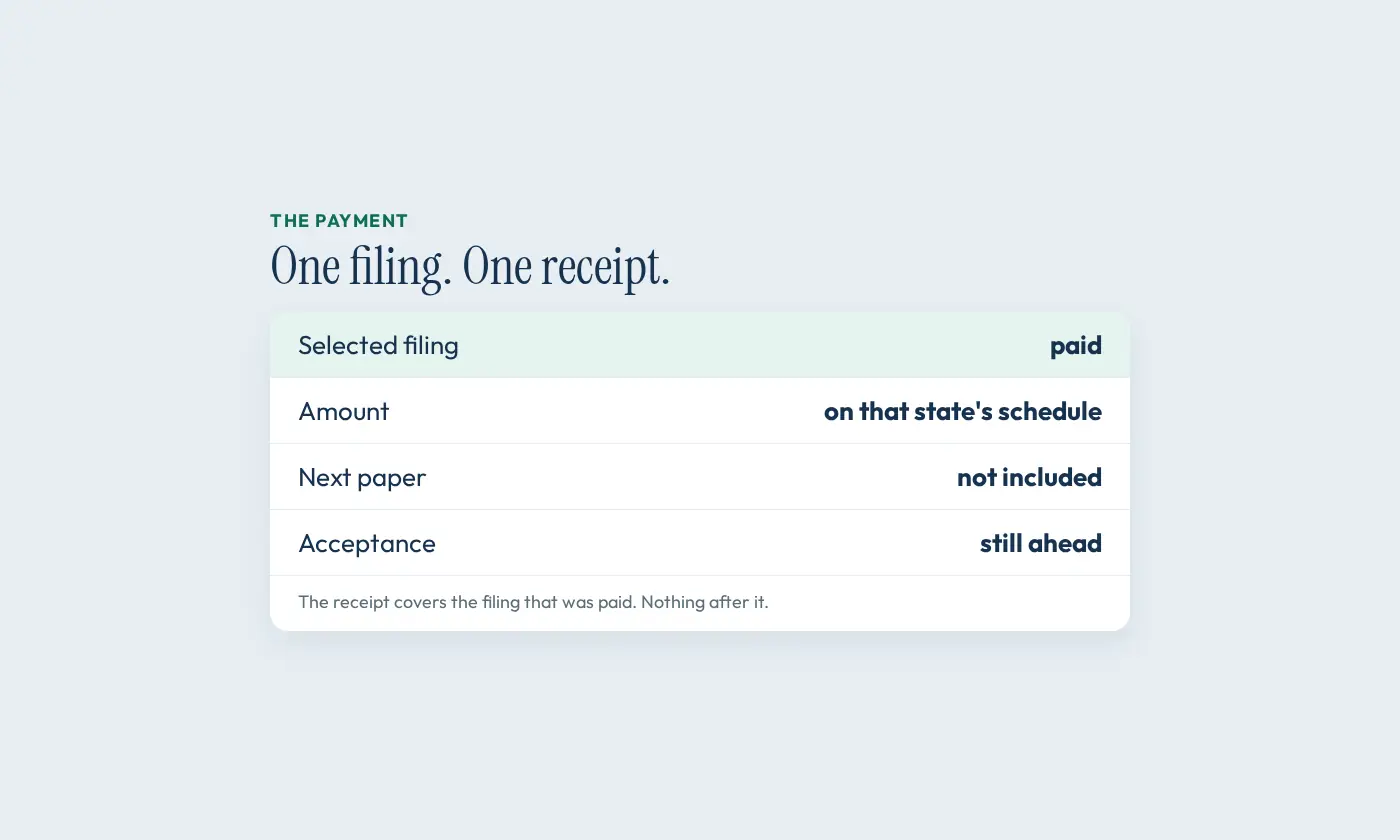
The receipt covers one selected filing. The amount is on that state's schedule. It is not printed here.
Bring the receiptA state filing office sells specific acts. Form the company. Change the agent. Amend the name. Reinstate a company that lapsed. Each act has a line on that state's fee schedule, and the schedule changes. This page will not freeze a figure that the office can revise next season. The receipt in your folder is the figure that mattered on the day you paid.
The receipt buys the act you selected and nothing beside it. It does not buy Form 2553. It does not buy a federal identification number. It does not buy an acceptance letter. It does not buy a payroll account. Owners pay the state, receive a confirmation, and feel the rest of the list should be included because the amount felt large. The list is not included.
Read the receipt for the act. If the act is formation, you have a company. If the act is a change of agent, you have a new place for mail and you may have had a company for years. Treating every receipt as a birth certificate is how an old company gets described as new.
The invented pizza counter from no client file paid a formation fee and a separate agent fee on the same morning. By lunch the owner had added the two amounts into one story about being fully registered. The federal form was not in the stack. Adding the amounts did not add the form. Your counter, if you have one, can make the same addition. The arithmetic of the invoices is not the arithmetic of the election.
Software that offers to file for you often shows one checkout. Behind the checkout there may be a state fee, a service fee, and a registered-agent subscription. The confirmation email still needs to be opened. Which governmental act was submitted. Which part was only the vendor. Pull the checkout into the state fee, the vendor fee, and the agent subscription before anyone discusses the year.
A refund, a rejection, or a deficiency notice means the act may not have completed. Payment attempted is not payment accepted. If the state asked for a correction, the company may not exist yet, or the amendment may not be on the record. The note should mention a rejection if there was one. A cheerful checkout page is not the record.
Publishing a fee here would be a guess by next year, and a guess is the wrong kind of help. The office that charges the fee publishes the schedule. We will look at the schedule with you on a call if the receipt and the schedule disagree. We will not type the schedule onto a marketing page and let it go stale.
Federal timing is different. The election window is written in the Form 2553 instructions, and we do state that window because it is a rule about days, not a price. No more than two months and 15 days after the tax year begins, or during the prior year. That sentence is not a fee. It is a clock. The clock and the price get confused only because both arrive in the opening month.
Payroll setup has government accounts too, and those accounts can have their own enrollments. They are not purchased by the formation receipt. A withholding account and an unemployment account are opened with the state that cares about wages. The provider you run usually knows the enrollment. We point the provider at the right status after acceptance. We still do not run payday.
The useful upload is the receipt or the confirmation that names the act. A text message that says we paid the state is a rumor of a receipt. We can start from the rumor, and we will ask for the paper before we treat the act as done. If you have two receipts, say which is formation and which is the agent.
Once the act is clear, the federal question is allowed back in. Blank form, signed form, or acceptance in hand. The payment page exists so the receipt stops being asked to do the other jobs. Steven Palmieri keeps the books on the far side of that clarity.
If the only thing you know is that a card was charged, write that. A charge without a named act is a fact. It is an early fact. It is enough for the note.
Say which act the receipt names. Formation, agent, amendment, or you are not sure.

You will be talking to the Steven Palmieri practice.