Register S CorpStep 1, form your company with the state
Before you can be an S corp, the company has to exist. Here's how forming it with your state works.
Get help with step 1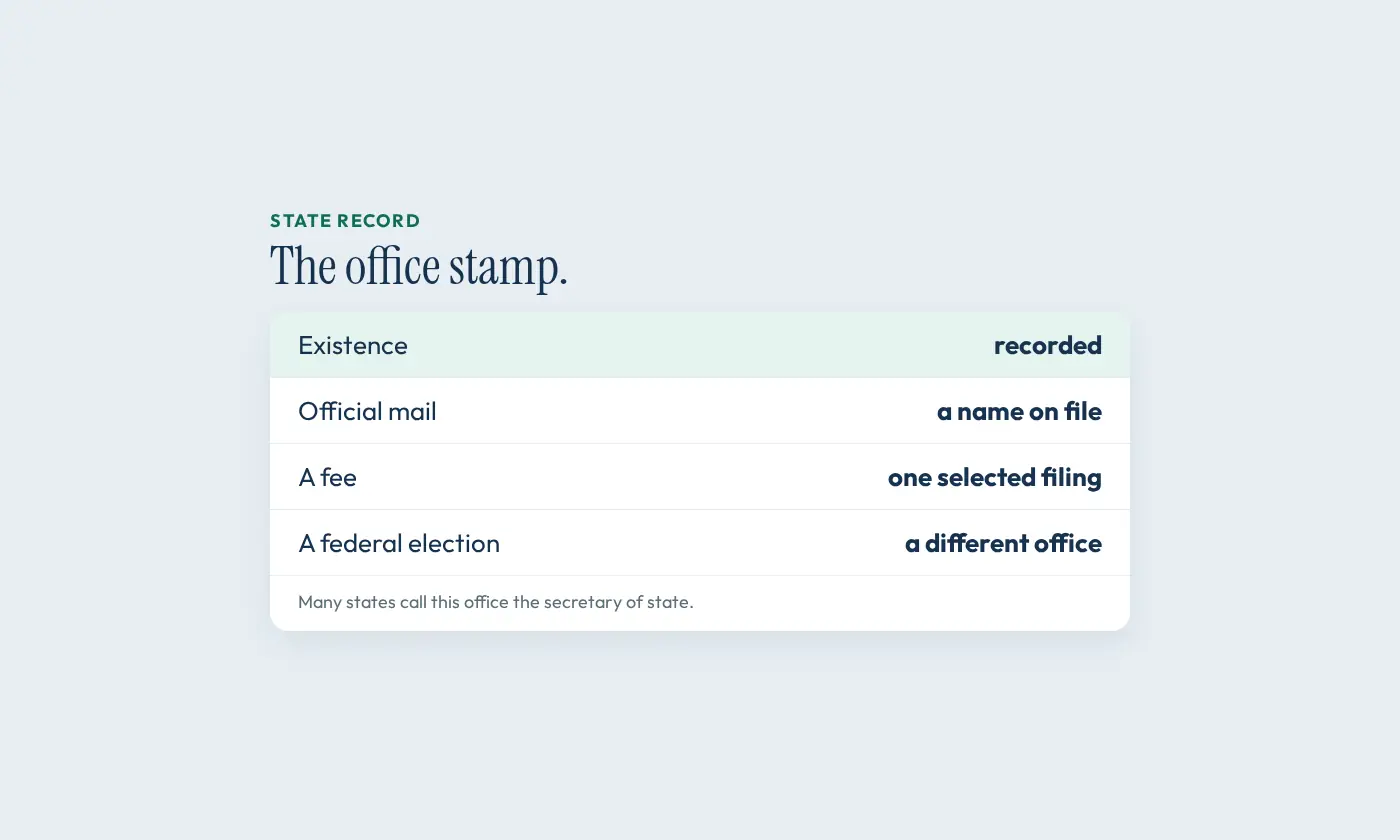
Before you can be an S corp, the company has to exist. Here's how forming it with your state works.
Get help with step 1Every state has an office that forms new companies. In many states it's the secretary of state. Others call it a division of corporations or a business filing office. Most let you file online.
For an LLC you'll usually file articles of organization. Some states call it a certificate of formation. For a corporation you'll file articles of incorporation.
The form asks for the company's name, a registered agent, an address, and the people forming it. A corporation also lists its shares. Check that your name is available first. Most state sites have a free name search.
Both can become an S corp. An LLC is often simpler to run. A corporation has shares, a board, and bylaws from the start.
An LLC that files Form 2553 on time is treated as a corporation for federal tax from the date the election starts. It doesn't need a separate Form 8832. Under state law it stays an LLC.
Which one fits depends on your plans, your state, and how you want to run the company. A lawyer can help with the company agreement and liability questions, and we're glad to work alongside yours.
When the state accepts your filing, you get a certificate, a stamped copy, or a receipt. It shows the company's name, its file number, and the date it was formed. Keep it, because your bank will ask for it.
The state's public record shows the company's name, type, registered agent, and whether it's in good standing. Your federal tax status lives with the IRS, so the IRS acceptance letter is the paper that shows you're an S corp.
Good standing means you've kept up with the state's reports and fees. Put the state's annual report date on your calendar so you stay current.
With the company formed, get your EIN on IRS.gov. Then you're ready for Form 2553.
If your company already exists, look it up on the state site. Check that the name, the agent, and the address are current. If something is out of date, it's usually a short filing to fix.
Tell us the date the company was formed. That date helps us work out your Form 2553 deadline on the call.
Can I form the company in a different state from where I work? You can, but you'll usually also have to register in the state where you do business and pay that state's fees too. For most small businesses, forming in your home state is simpler.
How long does it take? Online filings in many states come back within a few days, and mailed filings take longer. Your state's site lists its current times.
Do I need a lawyer? Many owners form an LLC on their own on the state site. A lawyer helps with the operating agreement, ownership splits, and liability questions.
Pick a company name, plus a second choice in case the first one is taken.
Decide who your registered agent will be, and have that person's or service's street address in the state.
Have a mailing address for the company and the names of the people forming it. For a corporation, decide how many shares it can issue.
Have a card or bank account ready for the state fee. Most states take payment online when you file.
Formed already, or still choosing between an LLC and a corporation? Tell us, and we'll help with the next step on a free 30-minute call.

You will be talking to the Steven Palmieri practice.